
What a wonderful summer we’ve had at Emancipate NC with our three incredible interns. We are so grateful to Hannah Mitchell, Jay Pittman, and Johna Speller for their work and contributions! We can’t wait to see what comes next for this group.
In their own words:

This summer, I’ve had the privilege of supporting Emancipate NC’s work on two cases on behalf of transgender women and the South Carolina books lawsuit. Across these matters, I’ve contributed legal research, drafting, and litigation support in cases that challenge state violence, defend the rights of incarcerated people, and confront systems that criminalize, censor, and disappear marginalized communities. From fighting for the dignity and safety of incarcerated transgender women of color to challenging censorship behind prison walls, these cases have shown me what it means to practice movement lawyering alongside directly impacted people and organizers. It’s been an incredible opportunity to learn from attorneys who understand litigation not as an end in itself, but as one tool in the broader struggle for liberation.
—Jay Pittman
Shifting the Narrative on Youth Civic Engagement
Since the presidential election in 2024, many young adults have felt disconnected from the power of the vote. Despite efforts to motivate younger generations that their voice matters, the outcomes of recent presidential elections, congressional decisions, and Supreme Court rulings demonstrate that it may not matter as much as we hope. How can you tell a group of people that they can decide their future, but their future is being determined by people who have nothing in common with them? It’s like asking someone what flavor of ice cream they want, and buying them pizza instead. This is the dilemma affecting many Americans today. The choices of government officials are affecting how people eat, live, and breathe. Instead of enjoying their youth, furthering their education, and starting their careers, they are concerned with how they can attend schools with quality education, afford housing and food, and survive walking down streets without being kidnapped by unidentifiable “officers.”

Young adults have not only been thrown into a world they have not been taught to survive in, but they have also not been given the proper tools to change it. Additionally, the pressure to vote comes with overwhelming anxiety. Young adults are told that they are not doing enough to fix the future, but how can they when the decisions of the past keep preventing them from moving forward? As history continues to repeat itself, it’s hard to determine which issues to fix first. And even if they had the opportunity to fix them, what’s to say the issue won’t come back again?
Not only do youth feel disempowered in their votes, but they are also struggling with fatalism. As a result of this, it comes across that young adults don’t care about the issues that affect them. This couldn’t be more wrong. Not only do they care too much, but they care more about the issues they can actually change.
Instead of writing a narrative against youth civic engagement, I believe that there are four ways we can better target meaningful engagement in voting. First, we should encourage youth to affect change that’s close to them. This means connecting with the grassroots organizations, non-profits, and community advocates who are engaging in the issues that are affecting their neighborhoods, schools, and jobs. Instead of being discouraged by how big the problems seem, they may feel more motivated if problems are smaller and quicker to fix.
Second, we should increase the education on the voting process. The presidential vote isn’t the only vote that matters. If we place a higher importance on voting for local officials, Congress, and state government, more communities will have a say in the policies that are directly impacting them.
Additionally, we should make the engagement more relatable. If millions of young adults can come together to vote for their favorite couple on Love Island, then they can come together for the votes that really matter. By making the vote accessible and popularizing it through social media, young adults can be further engaged in a larger context.
And lastly, there should be more opportunities to show that their voices matter. Many of today’s politicians have not been held accountable for failing to enact or uphold the policies they were elected for. If we truly want to show that young adults’ voices matter, then we must prioritize youth decisions, encourage valuable participation, maintain the values of democracy, and remove those that don’t reflect the future we decided on.
Therefore, when it seems like our vote doesn’t matter, we must show that it does. This includes holding both our politicians and our communities accountable. The narrative that youth are not civically engaged does not reflect the real truth. When they engage in voting and community advocacy, oftentimes their engagement seems inconsequential. Thus, by increasing community education, advertising local initiatives, and placing the power back into their hands, we will show that youth engagement really matters.
—Hannah Mitchell
Reflecting on a Transformative Summer at Emancipate NC
I have had a tremendous time interning at Emancipate NC this summer. For a long time, I have been interested in working as a social entrepreneur, but my vision has often felt unconventional compared to traditional non-profits. I have always wanted to build a racial justice initiative that seamlessly merges grassroots organizing with legal representation. Being at Emancipate NC has inspired me to believe that this vision can become a successful reality. Working alongside the organization’s incredible team of community organizers and criminal and civil attorneys has been a profound privilege.
During my time here, I have been able to contribute to meaningful work across multiple fronts: supporting attorneys on indigent criminal defense cases, visiting multiple courts across North Carolina, visiting the NC General Assembly, and supporting the opening of the Amani Collective Community Center in Greenville, NC. Every aspect of this internship has deepened my understanding of the legal system and reinvigorated my long-term commitment to ending mass incarceration and dismantling structural racism.
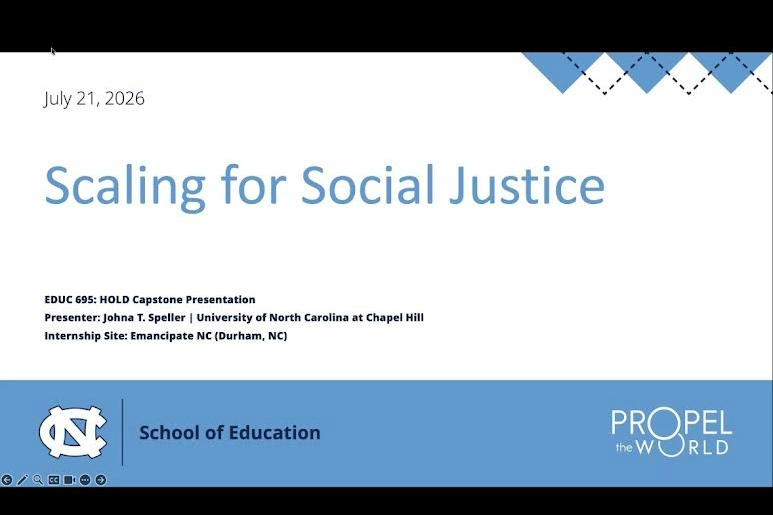
Additionally, Emancipate NC generously supported and allowed me to complete my senior capstone project for the Human and Organizational Leadership Development (HOLD) program at UNC Chapel Hill as part of this internship. The HOLD capstone bridges academic theory and real-world practice by partnering with an organization to address a critical “problem of practice” using data-informed approaches and continuous improvement.
- Capstone Site: Emancipate NC
- Project Title: Scaling for Social Justice
- Abstract: This HOLD capstone project investigates organizational scaling strategies within social justice non-profits. In 2026, organizations nationwide are navigating an increasingly complex environment where expanding social justice impact amid political resistance and limited resources is a severe obstacle. This reality raises a pivotal question: How can non-profits sustain or expand their impact under adverse conditions? Using Emancipate NC as a primary case study, this project highlights their initiatives as an exemplar of how to strategically scale vital programming and widen community impact without compromising staff capacity or organizational health.
In conclusion, thank you to everyone at Emancipate NC for the crucial, highly impactful work you do every day, and for allowing me to be a part of it this summer. This is an experience I will deeply cherish for the rest of my life.
—Johna Speller