
By Attorney Jaelyn Miller
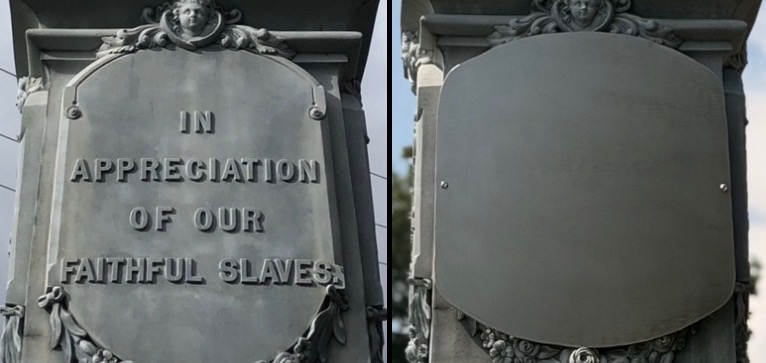
The Tyrrell County monument was erected in 1902, decades after the Civil War and during the era when white supremacist governments were consolidating power across the South. The monument’s largest text is a massive panel with the inscription praising “faithful slaves” and promoting a false narrative about slavery: that enslaved people were loyal, content, and grateful to those who enslaved them.
That message was not simply carved into a private object. It was placed on government property, directly outside the county courthouse.
For Black residents entering that courthouse, the monument communicated something very different from the county’s claimed commemoration of history. It invoked a system of racial domination at the very place where residents are supposed to have equal access to justice.
That is why the residents who challenged the monument did not simply argue that it was offensive. They argued that the government’s continued display of this message violated their constitutional right to equal protection.
The Community Didn’t Give Up: Tyrrell County’s “Faithful Slaves” Inscription Is Finally Covered
The lawsuit was only one part of a much longer struggle.
The Concerned Citizens of Tyrrell County have been organizing against the Confederate monument outside the Tyrrell County Courthouse since 2019. They held demonstrations, demanded action from county commissioners, and refused to let the issue disappear.
In 2022, Emancipate NC joined them in that fight. We wrote to the County Commissioners calling for the monument’s removal and helped the Concerned Citizens erect two billboards along U.S. Highway 64 demanding action.
In 2024, Black residents of Tyrrell County and the Concerned Citizens of Tyrrell County filed a federal lawsuit challenging the inscription. Emancipate NC attorneys Jaelyn Miller and Ian Mance represented the plaintiffs.
The Tyrrell County case demonstrated the power of using constitutional litigation to challenge racist government action even when state political structures make change difficult.
Public Space Is Never Just Public Space
There is a tendency to treat monuments and memorials as harmless relics of the past—as though simply being old makes them apolitical.
But government spaces communicate values.
A courthouse is not a museum. It is a place where people go to seek justice, exercise their rights, resolve disputes, and interact with their government.
When a government chooses to place a monument celebrating the Confederacy—and particularly a message romanticizing slavery—at the entrance to that courthouse, that choice has consequences.
Research examining Confederate monuments at courthouses has found that these symbols can make Black and Latino Southerners feel less safe and welcome and can cause Black residents to perceive the justice system as less fair toward people like them. (Cambridge Resolve)
That matters.
Equal justice cannot simply be a promise written in a courthouse’s rules. People must also be able to enter government institutions without being confronted by messages suggesting that their ancestors were meant to be subordinate.
This Is What Strategic Litigation Looks Like
The Tyrrell County case is part of Emancipate NC’s broader work to dismantle systemic racism and reclaim public spaces.
Our approach has never been limited to asking whether something is offensive. We ask a deeper question:
What happens when government itself endorses a message that tells Black people they are less valued, less welcome, or less entitled to equal treatment?
Sometimes the answer is organizing.
Sometimes it is public advocacy.
And sometimes it is litigation.
In Tyrrell County, community members chose all three.
The result is that a message glorifying slavery is no longer displayed on the courthouse grounds—and the case established an important legal precedent for challenging racist government speech under the Equal Protection Clause.
Reclaiming Public Space, One Community at a Time
Across North Carolina, communities continue to grapple with monuments and symbols created during periods of racial terror, segregation, and white supremacy.
These fights are ultimately about more than statues.
They are about who gets to define our shared public spaces.
They are about whether government buildings communicate belonging or exclusion.
And they are about whether Black communities have the power to challenge government when its actions perpetuate racial inequality.
The residents of Tyrrell County showed what is possible when a community refuses to accept that history must remain frozen in place simply because a monument has stood for generations.
Public spaces belong to the people who live in them—not to the ideology that created them.
Emancipate NC is proud to stand with communities fighting to make that principle real.