
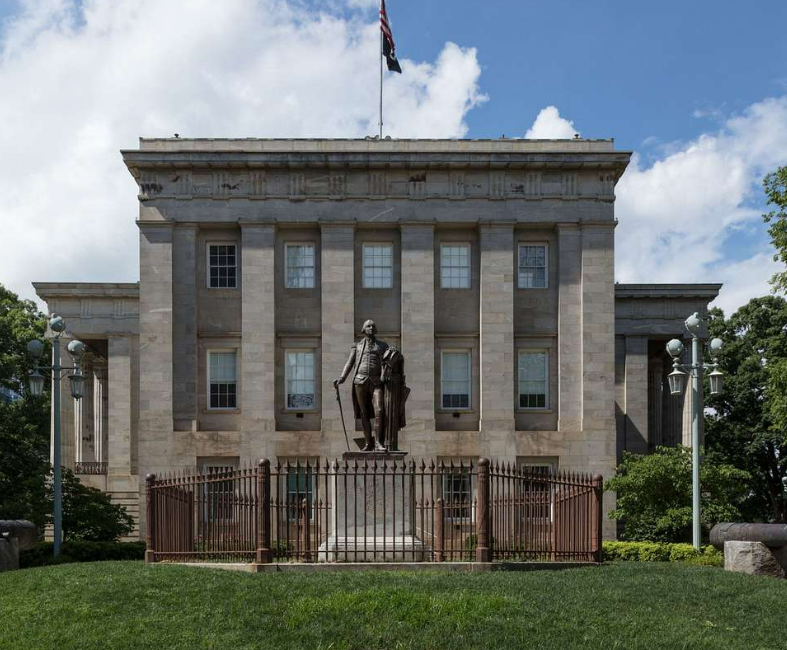
North Carolina lawmakers have found millions of dollars to fund new monuments honoring the Revolutionary War and evangelist Billy Graham, but a long-promised monument recognizing the contributions of Black Americans on the grounds of the State Capitol remains unbuilt. For Emancipate NC Executive Director Dawn Blagrove, the decision raises important questions about whose history North Carolina chooses to honor—and whose contributions continue to be overlooked.
Two recent news reports have brought renewed attention to the issue and featured Blagrove’s powerful commentary. In a November 9 article, Hoodline reported on the state’s decision to fund the Billy Graham and Revolutionary War monuments while the Black History monument remains stalled. That same day, WUNC published an in-depth report, “Promise unfulfilled: Union Square still without monument to honor Black North Carolinians,” featuring an interview with Blagrove about the state’s failure to move forward with the project.
The effort to establish a Black History monument at Union Square in downtown Raleigh dates back to 2017. Following the deadly white supremacist rally in Charlottesville, Virginia, then-Governor Roy Cooper called for Confederate monuments to be removed from the State Capitol grounds. A committee of the North Carolina Historical Commission subsequently recommended that the state construct one or more monuments honoring the accomplishments and contributions of Black people. The commission specifically called for the project to move forward without delay.
Nearly eight years later, that promise remains unfulfilled.
In her interview with WUNC, Blagrove did not mince words about what she sees as the underlying reason for the state’s inaction. Addressing the General Assembly’s failure to fund the monument, she said lawmakers have demonstrated a “lack of political will.” She went further, stating that legislators have shown “no desire to acknowledge the contributions of Black people” or memorialize them on the grounds of the Capitol.
Blagrove also connected the stalled monument to broader efforts to diminish the recognition of Black history, including the state’s restrictions on diversity, equity, and inclusion instruction in public schools.
For Emancipate NC, this issue is particularly significant given the organization’s longstanding work challenging Confederate monuments and the narratives they represent. Blagrove emphasized that removing monuments honoring white supremacy is only part of the work. Equally important is ensuring that public spaces recognize the full history and contributions of Black Americans.
As she told WUNC, the state must recognize the importance of investing in monuments that tell a more complete and historically accurate story. The article also revisits one of Blagrove’s central points: “Do I think that throwing a few million dollars to a monument is frivolous? No.”
The contrast in state spending makes the continued delay especially striking. While the Black History monument has repeatedly failed to receive funding, the state budget passed in July 2026 included funding for monuments honoring Billy Graham and North Carolina’s Revolutionary War history, both planned for Union Square.
The debate is about more than statues. Public monuments communicate whose lives, histories, and contributions a state considers worthy of recognition. As Dawn’s comments make clear, honoring Black history requires more than historical signage or symbolic acknowledgment. It requires a commitment to recognizing the achievements, leadership, and contributions of Black North Carolinians as an essential part of the state’s history.
We are proud of Dawn for continuing to challenge these disparities and insist that Black history be recognized in the places where North Carolina tells its story.
Read the coverage: